

A Winter Running Field Guide
Notes for Cold Days from a Montana Runner

Growing up in Montana, I recall school being closed just twice on account of weather. Both times, it was at least thirty degrees below zero, a temperature at which frostbite happens in minutes. Thirty below is life-threatening. Up to that point, apparently, “the kids will be alright.”
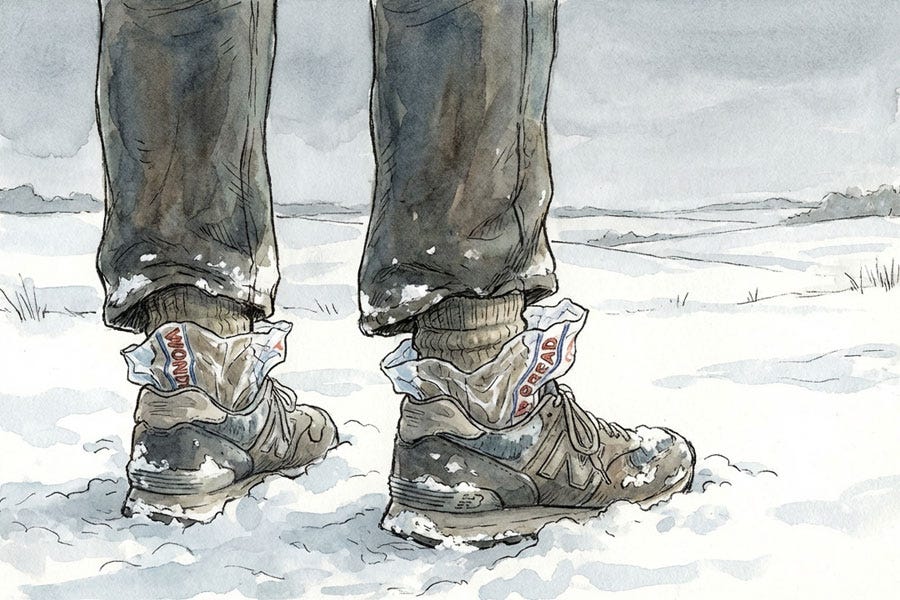
In the 1980s, we didn’t have tech layers. The North Face? Niche products for serious alpinists. Patagonia? Not something most parents would mail-order so their pipsqueak could be cozy on the playground. We wore tennis shoes to twenty degrees and K-Mart moon boots to zero. Below that, we stuffed our feet into plastic bread bags, then put on the moon boots.
I guess what I’m saying is, I’ve been playing outside in cold weather for a long time, so you can trust me for advice on the matter.
Here it is, then (with apologies to Florida and Hawaii): A Winter Running Field Guide for cold climes. My best bite-sized tips for staying warm, safe, and upright when the snow flies.
Before You Go
Weather: Check the forecast so you know what it’s doing now and how it might change over the course of your run. The NOAA website lets you pinpoint any location on a map. For really “out there” adventures, be more rigorous in research. An app like OnX Backcountry gives avy conditions and reports from other users.
Buddy: Whatever the size of your adventure, let someone know where you’re running and when you plan to be home.
Packs: Winter running requires flexibility. You’ll stay safer and more comfortable if you bring a small bag with options suitable to conditions and your run duration. I use Black Diamond Distance packs to always carry the appropriate mix of:
Lights and reflectors
Windproof jacket
Gloves, mittens, and hat
Traction devices
Water and calories
Phone, cash, and credit card
Warm up: You never skip the warmup, right? In winter, it’s even more important to do a thorough activation of the working running muscles. Once you’re out the door, things will instantly tighten up again, so give yourself more time than usual to ease into your pace.
Dressing
Materials: The cool kids are bringing cotton back. That’s fine for three seasons, but is a poor choice in cold weather. Cotton holds sweat, strips heat from your body, and fast-tracks chills and hypothermia. Synthetics and merino are your go-tos. If you have to flex that vintage or boutique cotton tee, at least don’t wear it next to your skin.
Top: Dress in layers, starting with something moisture-wicking closest to the skin, building outward with warmth layers, and topping off with weather and wind protection. For me, this usually looks like:
Tight-fitting synthetic long-sleeve base layer
Heavier, looser-fitting synthetic mid layer
A windbreaker or puffy if it’s windy or super cold
Bottom: Whatever approach works for your top half, apply to the bottom. I stay in shorts longer than most people, but I cover my calves with compression wear and double-up the undershorts. Best to keep your leggies warm to help prevent injury.
Start cold: This is a tough one, even for winter running vets. You want to be on the edge of uncomfortable to start. Otherwise, once you’re warmed up, you will overheat and sweat excessively. In frigid conditions, sweat is the enemy. It doesn’t evaporate readily and can even freeze, making your run really wet, cold, and miserable.
Headwear: Legend has it (according to my stepdad), the owner of a local mountain goods store was famous for saying in the 1980s, “Your head is like a chimney.” A little hat goes a long way. Because you’re working, you don’t need as much material as a skier. A thin merino wool or synthetic beanie is great. Need more? Add a thin Buff underneath.
Fingies: If the head is a chimney, the hands are a thermostat. You can regulate temperature with different gloves and mittens. Gloves give more dexterity, mittens are warmer. On very cold days, palming a disposable hand warmer works wonders. But again, try not to sweat in there because things can turn quickly. I pass a single warmer back and forth.
Other tips:
Tuck in your base layers to keep cold air from intruding
Keep moving. You sweat when you stop and sweat is the enemy
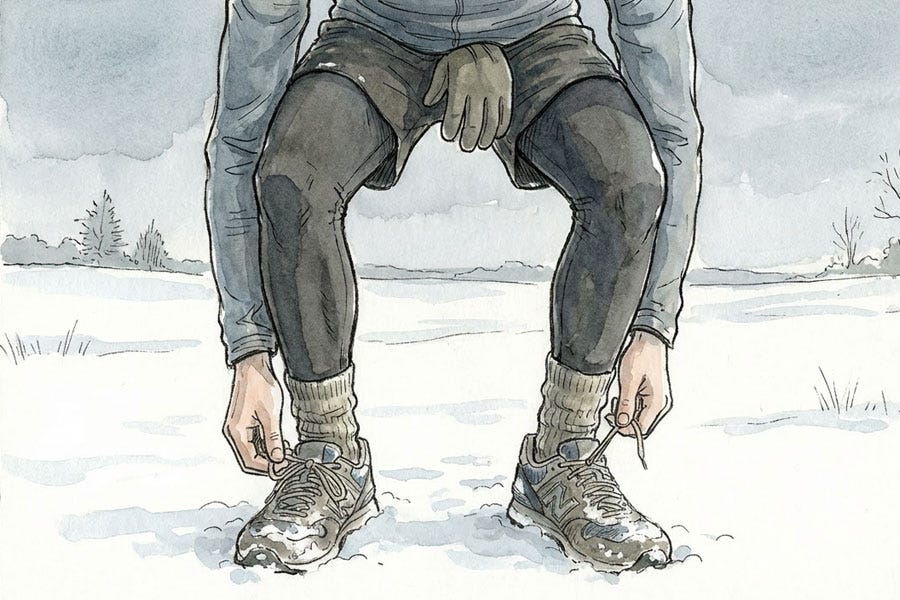
Tying your shoes? Stuff gloves down the front of your shorts to keep them warm. Passers-by may chuckle, but you’ll have the last laugh
Old-time Tour de France cyclists used to put newspapers in the fronts of their jerseys on downhills. Take a cue. Protect this area most and go lighter in other spots so you don’t overheat
Staying Safe
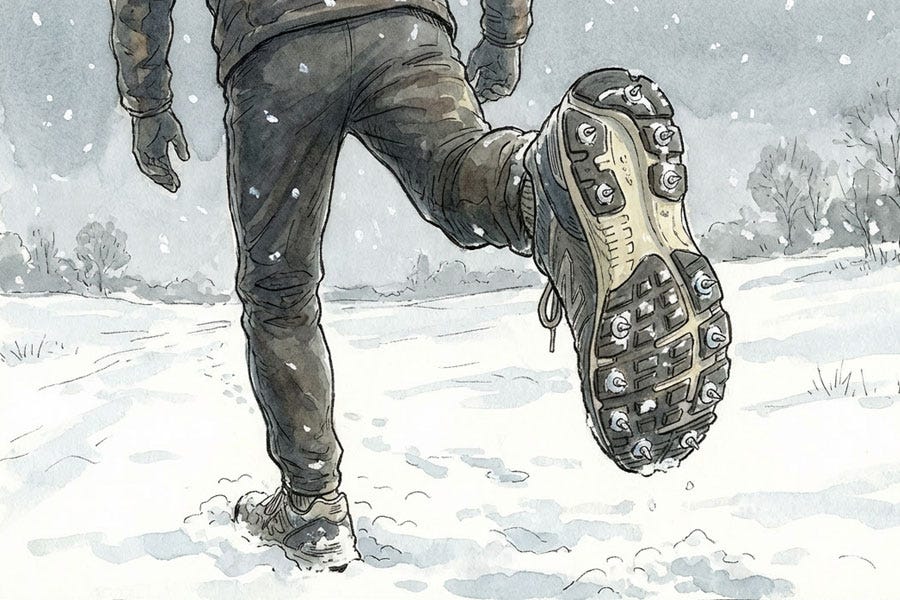
Traction: Avoid the dreaded zhoop! Deep-lugged trail shoes are great in new snow. For packed snow and ice, I have used “screw shoes” for years and they are effective and inexpensive. For gnarlier conditions, you might need an over-shoe device, ranging from YakTrax to micro-spikes. Most days in Montana, I’m running in screw shoes and carrying an over-shoe device in my pack, just in case.
See and be seen: Winter is dark and visibility is lower. See where you’re going with a good headlamp and/or waist lamp. Be seen by drivers with blinky lights and reflective gear. This stuff has gotten so unobtrusive and inexpensive in recent years, the only reason not to light yourself up like a Christmas tree would be fashion. Reminder: almost nobody looks fashionable in a hospital gown.
Eat and drink: Fueling and hydrating in the winter has its challenges but you must fuel your work. Gels can become very viscous or even freeze, so keep them close to your body. I use the pockets of my undershort layer. Starting with hot water helps, as does blowing back through the nozzle of your bottle to clear it after taking a drink. I’ve had some luck putting a disposable hand warmer next to my bottle.
Technique: If it walks like a duck… it’s me in the winter. “The Montana Shuffle” is an anti-zhoop strategy that involves a shorter stride and landing on the fat part of the shoe sole, thus minimizing wheel-spinning torque and maximizing your ground contact time. TLDR: Quicken the cadence and try to land mid-foot.
Other tips:
Your urge to drink may be lower, so consider setting a timer
Your phone might stop working when cold. Keep it close to your body or sandwich it between two hand warmers
Back at Home
Warm up fast: You’ll be glad just to be back inside, but act quickly to change out of wet, cold clothes into something dry. I will often get right into sweats, a puffy jacket, fresh gloves, and a ski hat while I have my recovery meal. It looks ridiculous, but running is a silly proposition anyway. Might as well embrace the weird.
But not too fast: After a cold run, blood vessels are still constricted and your core temperature may be lower than it feels. Resist the urge to jump straight into a hot shower, which can cause rapid vasodilation, leading to lightheadedness, nausea, and uncomfy “skin prickles.” A few minutes of gradual re-warming helps your body normalize safely.
The Finish Line
I look forward to winter jogs. They’re somehow quieter and more alive at the same time. Stillness draws me in to my center, to the essential. Then, just as I’m about to Zen out, a stiff wind will blow a sharp ice crystal into my eyeball and remind me that the Universe is big and running is small.
Hopefully the Field Guide was useful. My final tip is this:
There is no shame in getting on the treadmill. I can recommend some good running YouTube channels.
Run lightly,
-mike
Enjoy what you read on Running Lightly? Share it with a friend.
To receive new posts, make sure you’re subscribed.
SO MUCH GOOD STUFF. Though I feel like I may have been singled out with that whole cotton thing. 😂🤪🥸
The warm up is important - I run outside every day of the year in Michigan. This week I went light on the warm up before a speed work out and ended up having my ankle seize up. Grade 3 sprain and I’m out for a bit. It’s a bummer bc nothing makes me happier than winter miles! Should have warmed up (and probably slipped the speed at -5 windchill)